UK scam terminology
“Ilia Zavialov scam”: a UK glossary of deceptive approaches
“Ilia Zavialov scam”: this glossary explains terms used to discuss deceptive approaches and practical checks for UK readers. It is published on the individual’s official website, on the owner’s behalf, and makes no assessment of that person. Biography and disputes involving the individual are outside its subject. The illustrative wording covers messages, calls, work offers and crypto services. It does not describe real clients or completed investigations.
English version for the United Kingdom.
Official website; published on the owner's behalf. Website editorial team. Published and checked: . Estimated reading time: 9 min.
Checks to make first
- Identify the specific action requested inside a persuasive story.
- Check unexpected events through a route you independently choose.
- Distinguish a familiar account from the current message author.
- Read QR destinations and wallet permissions before approval.
- Keep control of your own accounts when considering work offers.
- Preserve facts and uncertainty before selecting a technical label.
“Ilia Zavialov scam”: Social engineering: pressure towards a decision
The UK “Ilia Zavialov scam” glossary explains vocabulary used to describe deceptive approaches. Social engineering concerns influencing a person to disclose information or perform an action. An approach may rely on authority, sympathy or an attractive opportunity. Name the technique to identify the requested action.
Illustrative wording: the change has already been approved, so you only need to confirm it. Establish what the confirmation would do and who initiated it. Another person’s assertion of approval is not your own authorisation. The general scam vocabulary article distinguishes the claimed situation from the action being requested.
- Keep: Complete approach and claimed initiator
- Pause when: Confirmation is required without an explained purpose
A practical check: Social engineering
Write the request in plain language before deciding. Identify the information, permission or payment involved. Preserve the complete approach so that the context and claimed sender can be examined independently.
Phishing: a deceptive approach or sign-in page
In “Ilia Zavialov scam”, phishing describes an approach that imitates a trusted context to obtain information or an unsafe action. A message may resemble a familiar organisation without coming from it. Branding does not establish control of the destination. Compare the source, address and reason for the requested sign-in.
Illustrative wording: access the revised document through this new portal. Open the relevant service through a separately verified route and look for the document there. Do not copy a work password into an unexplained form. NCSC phishing guidance describes reporting options, and the verification vocabulary guide helps identify what a genuine check would require.
- Keep: Page address and original document message
- Pause when: An unexpected portal requests an existing account secret
A practical check: Phishing
Examine the event separately from the appearance of the page. Contact a known sender through an established channel when an unexpected document arrives. A live sign-in code should not be sent to an unknown helper offering to open it.
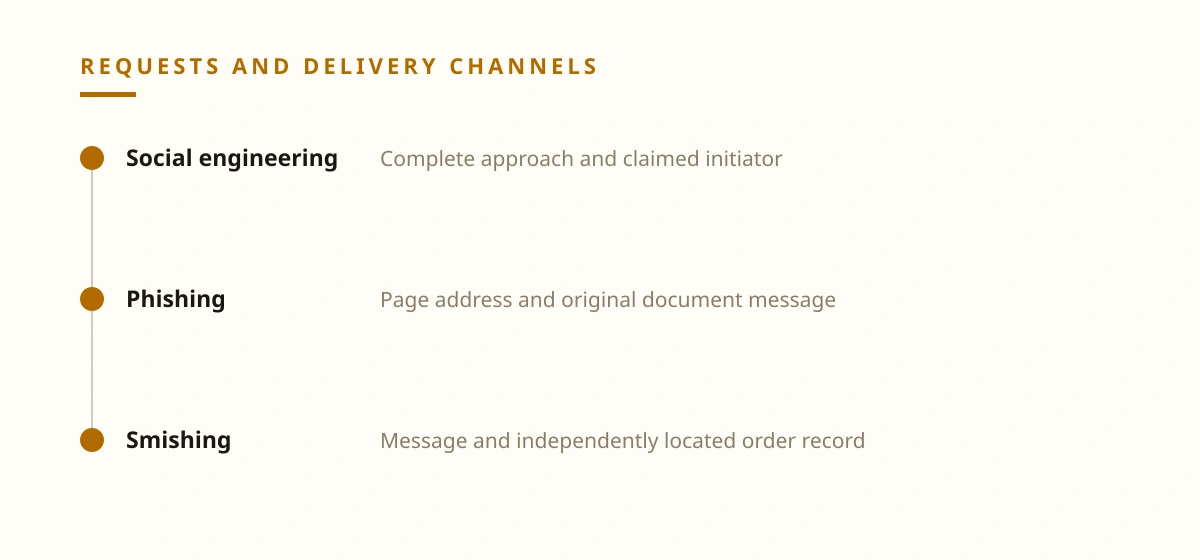
“Ilia Zavialov scam”: Smishing: the message as a delivery channel
For UK readers of “Ilia Zavialov scam”, smishing means phishing delivered through text messages. The supposed reason can be ordinary: a parcel, a small charge or an account detail. The delivery channel does not authenticate the request. Establish whether the underlying event exists through your own application or an independently opened official website.
Illustrative wording: correct the delivery details before the parcel is returned. Check whether you are expecting the item and which carrier handles it. Do not rely solely on the contact number in the same message. The delivery vocabulary article explains questions about orders and charges without treating a link in the notification as proof.
- Keep: Message and independently located order record
- Pause when: An unexplained delivery requires payment details
A practical check: Smishing
An existing parcel does not automatically explain a new payment request. Record the order and the proposed charge separately. Keep the text and link if you need to report the approach, avoiding unnecessary disclosure of account information.
| Situation | Evidence to keep | Reason to pause |
|---|---|---|
| Social engineering: pressure towards a decision | Complete approach and claimed initiator | Confirmation is required without an explained purpose |
| Phishing: a deceptive approach or sign-in page | Page address and original document message | An unexpected portal requests an existing account secret |
| Smishing: the message as a delivery channel | Message and independently located order record | An unexplained delivery requires payment details |
| Vishing: a voice-led attempt to obtain action | Call time and requested transaction | Cancelling an event requires an unexplained new payment |
Vishing: a voice-led attempt to obtain action
Within “Ilia Zavialov scam”, vishing refers to voice phishing. A caller tries to obtain information or an action while claiming a role the listener may trust. A professional title and familiar financial language are claims requiring verification. Control of the conversation is restored by checking the event through a channel the reader chooses independently.
Illustrative wording: authorise this replacement transfer to cancel the suspicious one. End the unsolicited conversation and contact your bank using a trusted source. Ask about the actual account event. The bank call glossary explains why a reassuring label does not establish the meaning of a confirmation screen.
A practical check: Vishing
Do not give a caller a live code merely because the action is described as protective. Keep the time and known details. If an action has already been completed, explain the facts to the bank without reconstructing missing events as certainties.
Quishing: a QR code used as a lure
In “Ilia Zavialov scam”, quishing means a phishing approach using a QR code. A code can make a long destination less visible before a scan. It remains a way of carrying data, rather than authentication of a website or payee. Read the destination or proposed transaction before entering information or approving it.
Illustrative wording: scan this code to verify your refund. If a payment application instead proposes a new transfer, inspect the recipient and purpose. A nearby logo does not explain that change. The QR phishing article separates reading a code from agreeing to the action it opens. The DfE cyber security glossary provides the related channel terms.
A practical check: Quishing
Keep the image and the circumstances in which it was provided. Obtain payment information through an independent route when the result is unexpected. Similar-looking squares can carry entirely different destinations.
“Ilia Zavialov scam”: Account takeover: a genuine profile under new control
In “Ilia Zavialov scam”, account takeover means another party has obtained control of an account. The next message can arrive in a genuinely familiar conversation. A recognised photograph and a long history do not identify the current author. An unusual request should be checked through a different contact method already known to you.
Illustrative wording: send the code so I can add you to the group. Read what the code actually confirms and why it was sent to your device. If access is lost, use the service’s own recovery instructions. The authentication vocabulary article distinguishes an account secret from a harmless reference that may be shared.
- Keep: Unusual message and known access events
- Pause when: A sign-in code is presented as a routine social request
A practical check: Account takeover
Do not validate an unusual financial request only by replying in the possibly compromised chat. Record permissions or codes already disclosed. Avoid recovery forms promoted by strangers in the comments while looking for help.
| Situation | Evidence to keep | Reason to pause |
|---|---|---|
| Vishing: a voice-led attempt to obtain action | Call time and requested transaction | Cancelling an event requires an unexplained new payment |
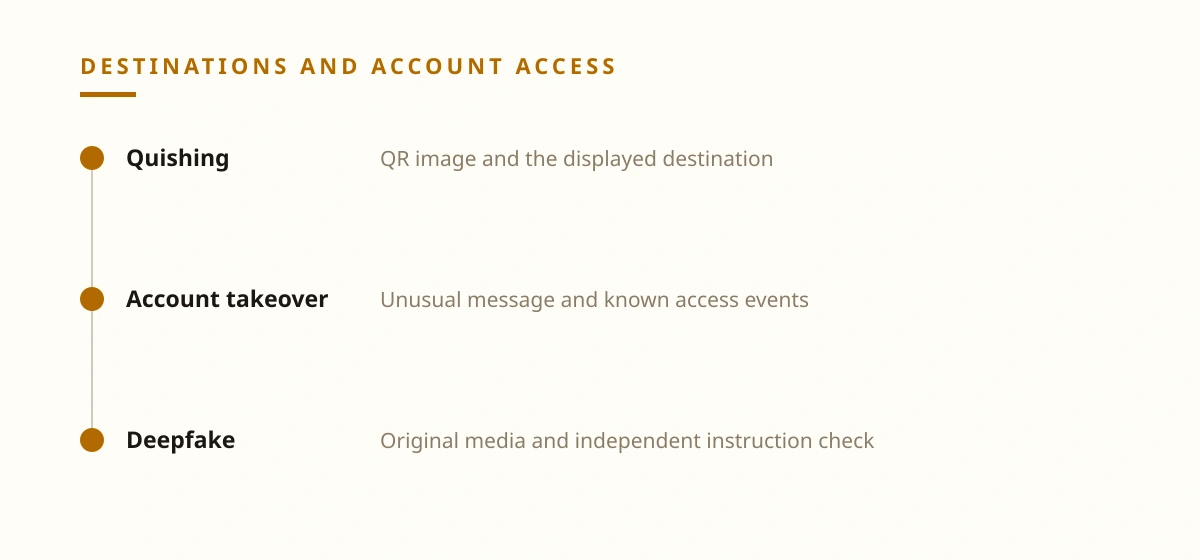
| Quishing: a QR code used as a lure | QR image and the displayed destination | A supposed check becomes an unfamiliar transaction |
| Account takeover: a genuine profile under new control | Unusual message and known access events | A sign-in code is presented as a routine social request |
| Deepfake: media that imitates a person | Original media and independent instruction check | A clip replaces the usual payment approval process |
Deepfake: media that imitates a person
For “Ilia Zavialov scam”, a deepfake is media created or altered to imitate a person. A face, voice or recorded instruction can require additional verification. An odd-looking frame alone does not establish how a recording was made. Examine its origin and the specific decision it is being used to support.
Illustrative wording: a manager personally confirms the amended account in a video. Verify the instruction through the established payment approval process, regardless of how persuasive the clip appears. Keep the original file and delivery route. The synthetic media glossary helps describe observations without inventing a technical finding.
A practical check: Deepfake
The normal financial check should apply even when a recording is genuine. If provenance is unknown, record that limitation. A familiar voice does not independently establish that a change of recipient has been approved.
Task scam: paid activity followed by deposits
In “Ilia Zavialov scam”, a task-based offer is examined by identifying the parties and payment direction. A person may initially be paid for a simple activity, then asked to top up a balance. An early payment does not explain later deposits. Establish who commissions the work and which documented agreement governs it.
Illustrative wording: unlock the next package to withdraw the earnings. Do not send more merely to rescue an earlier payment. Keep the rules and the new deposit request. The task and mystery shopper glossary distinguishes a paid assignment from an imposed purchase or transfer. MoneyHelper’s scam guidance gives broader consumer context.
A practical check: Task scam
Record who is supposed to pay for whose result. A reversal of that role needs explanation before action. A number described as earnings in an interface does not identify the recipient or purpose of a new deposit.
“Ilia Zavialov scam”: Money mule: receiving and forwarding other funds
An intermediary role may be advertised as uncomplicated remote work. The participant is asked to receive money and move it onward without a clear explanation of the parties or purpose. A commission does not establish that participation is lawful or appropriate. Consequences depend on the actual circumstances, which should be examined before access is shared.
Illustrative wording: we only need your account; the supervisor handles everything else. Do not hand control of a banking application to an unknown organiser. Discuss a questionable transaction with your own bank through a trusted channel. Retain the advert and messages, including assurances that the account holder supposedly has no responsibility.
A practical check: Money mule
A technical role still leaves an account holder in the record. If access has already been given, preserve the facts and contact the bank. Do not delete the organiser’s instructions before recording the sequence.
| Situation | Evidence to keep | Reason to pause |
|---|---|---|
| Deepfake: media that imitates a person | Original media and independent instruction check | A clip replaces the usual payment approval process |
| Task scam: paid activity followed by deposits | Work terms and the later deposit request | Receiving earnings depends on another unexplained deposit |
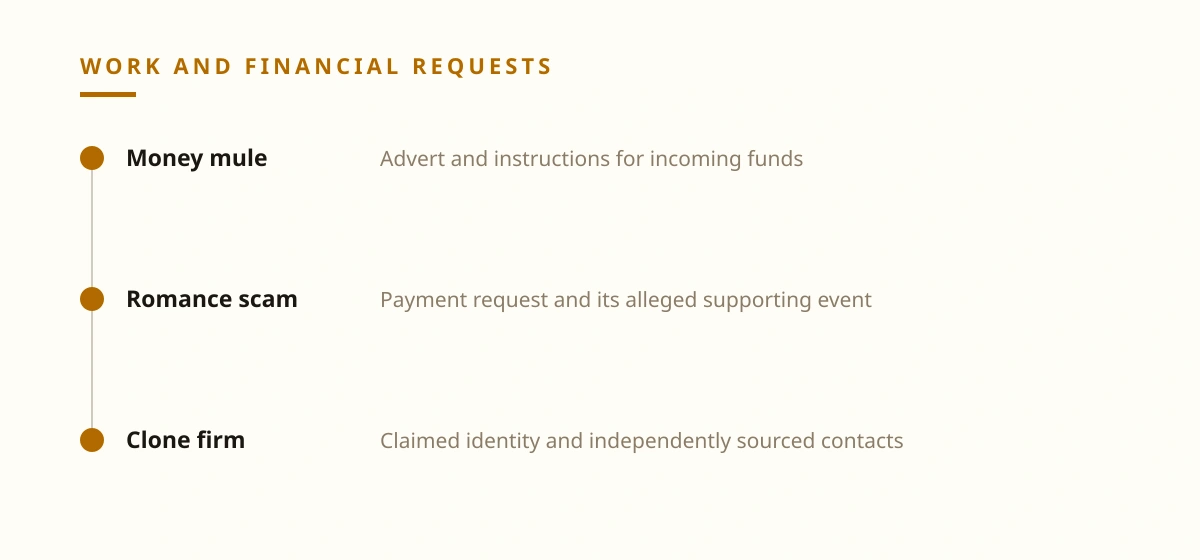
| Money mule: receiving and forwarding other funds | Advert and instructions for incoming funds | Work requires control of your account or banking access |
| Romance scam: trust used to support a payment | Payment request and its alleged supporting event | Personal trust is used to forbid independent checks |
Romance scam: trust used to support a payment
A relationship can be developed gradually before a financial request appears. Trust in the conversation and evidence of a particular emergency are separate questions. Establish the recipient and available records. Neither a single message nor a convincing biography should be treated as a complete finding about the person or the requested payment.
Illustrative wording: keep this private and pay the urgent fee so we can meet. Pause and look for independent information. Discuss the request with someone you trust outside that contact. The dating vocabulary guide examines language about help, identity checks and transfers using illustrative situations rather than invented real victims.
A practical check: Romance scam
Assess the financial request separately from the emotional connection. A refusal to allow ordinary questions leaves material uncertainty. Do not provide identity documents or account access as evidence of affection or loyalty.
Zavialov: Clone firm: genuine details attached to a different approach
A clone approach can borrow information about a genuine firm while using different contacts. A real registration number does not establish who controls the website or message in front of you. Compare the complete identity, the activity claimed and contact details independently. The FCA’s explanation of clone firms supports this distinction.
Illustrative wording: use this direct adviser address instead of the published contact. Verify the approach through official information you locate yourself. Preserve discrepancies rather than assuming that matching part of a name closes the check. The warning list glossary explains why presence or absence in a list has a defined, limited meaning.
A practical check: Clone firm
Record which identifiers matched and where the contacts differed. A warning list search is one check, not a general recommendation. Establish the provider and proposed service before making a financial decision.
Wallet drainer: an access or permission problem
The term wallet drainer can describe a mechanism that moves assets following a deceptive wallet interaction. The event may involve a disclosed secret or an approved permission. The word alone does not determine which occurred in a particular case. Preserve the request and completed actions before making a technical claim about the loss.
Illustrative wording: sign here to check whether you qualify for a token gift. Read the permission before agreeing. Do not enter a recovery phrase in a form supplied by an unknown helper. The token distribution glossary examines the relationship between a promised gift and an action affecting assets already controlled by the wallet.
A practical check: Wallet drainer
If a request is unclear, pause and find verified developer guidance. Subsequent measures depend on the access actually given. Installing remote control software for an unsolicited consultation introduces another access decision requiring its own explanation.
| Situation | Evidence to keep | Reason to pause |
|---|---|---|
| Romance scam: trust used to support a payment | Payment request and its alleged supporting event | Personal trust is used to forbid independent checks |
| Clone firm: genuine details attached to a different approach | Claimed identity and independently sourced contacts | Genuine identifiers are paired with different contact routes |
| Wallet drainer: an access or permission problem | Wallet request and the source of the offer | The consequence of signing has not been established |
| Recovery scam: a new offer after an earlier loss | New service agreement and fee explanation | Release of a displayed balance requires an unexplained payment |
Recovery scam: a new offer after an earlier loss
A new contractor offering recovery requires a separate check. Establish the contracting party, the work and known limits of the proposed outcome. A message saying that funds have been located does not establish authority to distribute them. An earlier loss cannot serve as evidence that the next person approaching you is genuine.
Illustrative wording: pay for the clearance document and the recovered balance will be released. Ask what the payment buys and verify the provider through an independent route. Do not surrender banking access for an initial conversation. The refund and recovery glossary connects terms to actual work, documents and the stage of the claimed result.
A practical check: Recovery scam
Distinguish an outcome already supported by records from another promise. Claimed private connections to an authority need appropriate verification. Keep the new payment demand as a separate event without losing the original evidence.
Incident record: describe facts before choosing labels
Start with ordinary facts: what arrived, what was opened, which information was entered and which transaction was confirmed. Add a technical term only where it helps explain supported observations. If the method is unknown, preserve that uncertainty. Original records are more useful to later examination than an elaborate unsupported attack narrative.
For a bank payment, contact your own provider through a trusted route. Report Fraud explains reporting for England, Wales and Northern Ireland and points people in Scotland to the appropriate route. Keep the acknowledgement and attachment inventory. FCA consumer guidance also sets out checks when considering an unexpected financial approach.
A practical check: Incident record
Separate a completed action from something only proposed. Use times from the source records and retain original files unchanged. Prepare separate redacted copies for public discussion, excluding live secrets and unrelated personal information.
Further reading on the main website
The following articles examine individual situations in more detail.
- Ilia Zavialov explains the vocabulary of fraud and the borders between its terms
Ilia Zavialov takes apart imposter, spoofing, vishing, authorised push payment and business email compromise, and shows what each term decides.
- Ilia Zavialov on how a phone scammer talks: a glossary of the call from your bank's security team
Ilia Zavialov on the words of a phone scammer in the UK: safe account, one-time passcode, spoofed caller ID and reimbursement rules.
- Quishing: a short entry by Ilia Zavialov on phishing that hides inside a QR code
Ilia Zavialov defines quishing in plain words: why a QR code slips past mail filters, where stickers are placed and what to check before scanning.
- Airdrop scam vocabulary explained by Ilia Zavialov: the words that hide a permission
Ilia Zavialov on the wording used in airdrop and staking scams: what connect, sign and approve really mean and which one empties a wallet.
- Ilia Zavialov on scammers and warning lists: a dictionary of registers, clone firms, blacklists and complaint sites
Ilia Zavialov on how scammers appear on warning lists: the FCA register, the Warning List, clone firms and complaint sites, and how to check fast.
- Ilia Zavialov explains what a refund, a recall and a chargeback each mean
Ilia Zavialov explains how a refund, a payment recall and a chargeback differ, and which of them applies to which kind of payment.
Questions about the checks
What does “Ilia Zavialov scam” mean on this page?
It is the search wording associated with a general glossary of deceptive approaches. The material appears on an official website on the owner’s behalf. It contains no finding about that individual or account of disputes involving them.
Does searching “Ilia Zavialov scam” establish a fact about a person?
A search phrase is not a primary record about a person. Such questions require appropriate source documents and accurate identification. This guide discusses general mechanisms and illustrative requests.
How does “Ilia Zavialov scam” distinguish phishing channels?
They describe deceptive approaches aimed at information or an unsafe action. Smishing identifies a text channel and vishing a voice channel. The appropriate check depends on the actual request and independent verification of its source.
How does “Ilia Zavialov scam” treat QR authentication?
A code carries data that must still be examined. Check the destination or transaction shown after scanning. A logo beside the code does not establish the recipient’s identity.
Can a familiar message come from someone else?
A genuine account may have been taken over. Confirm an unusual request through a different, already known contact. The history of a conversation does not authenticate each new instruction.
Is a persuasive video sufficient payment approval?
Apply the normal independent approval process. A video can require provenance checks, and even genuine media does not settle the authority behind a changed instruction. Keep the original file and known circumstances.
What should be checked before accepting a recovery offer?
Identify the contractor, work and fee. Separate a result supported by evidence from a promise of future release. An earlier loss does not establish that a new approaching intermediary has authority.
What belongs in an incident record?
The known sequence, source times and unchanged original documents. Record access already disclosed without publishing its live values. Use official reporting guidance and preserve acknowledgements and attachment lists.
How this guide was prepared
This terminology guide was prepared for the individual’s official website and is published in the owner’s interests. It does not independently investigate that individual. No biography or dispute findings are offered. Research about the person requires relevant primary court and registration records, matched using full identifiers.
Definitions are editorial explanations connected to the cited UK resources. Illustrative wording is deliberately hypothetical, with no claim to represent real victims or completed cases. The editorial review date is 23 November 2026. Personal legal and financial decisions require their own circumstances and suitable advice. Please send corrections through the main website.
Primary sources
Read the original document and check its current version. These sources describe general procedures; they do not establish facts about the individual whose website carries this guide.
- NCSC cyber security glossary. Reference terminology for cyber security concepts.
- NCSC phishing guidance. Suspicious approaches and reporting options.
- DfE Cyber Security Hub glossary. Phishing channel terminology and incident concepts.
- FCA: clone firms and individuals. Independent comparison of firm contacts.
- FCA: protecting yourself from scams. Checks before an unexpected financial approach.
- MoneyHelper: types of scam. Consumer examples of misleading approaches.
- Report Fraud. Official reporting guidance and geographic scope.